ServicesAC Installation
AC Installation in Ritzville, WA
We size, install and start up central air conditioners for your home. One person handles your job from the first measurement to the final walk-through, so you always know who to ask. You get a written quote before any work begins, and the estimate is free.
A new air conditioner that fits your home
A central AC system is two halves that have to work as a pair: the condenser outside and the evaporator coil inside, usually sitting on top of your furnace. When the two are mismatched, or the system is sized by guesswork, you get short cycling, damp air and a compressor that wears out early. Most of what makes an installation good happens before the old unit comes out.
Our process starts with a load calculation for your home, not a copy of the tonnage on the old nameplate. We look at square footage, insulation, window area and which way the house faces, then pick a condenser and coil that are rated to run together. Eastern Washington summers bring long, dry afternoons in the 90s, and a correctly sized unit runs long, steady cycles through them instead of slamming on and off.
The person who measures your home is the same person who answers your calls, schedules the crew and checks the work at startup. If something about the plan changes, you hear it from them directly.
What your AC installation includes
Load calculation
We measure the house and calculate how much heat it actually gains on a hot day. That number sets the tonnage, which protects you from an oversized unit that cools fast but leaves the air clammy.
Matched condenser and coil
The outdoor unit and indoor evaporator coil are selected as a rated pair so the published efficiency is what you really get. We confirm the coil fits your furnace cabinet and that the blower can move enough air across it.
Line set and refrigerant
New systems use newer refrigerants, so we check whether your existing copper line set can be reused or should be replaced. Brazed joints are made with nitrogen flowing through the pipe to keep scale from forming inside.
Pad, disconnect and wiring
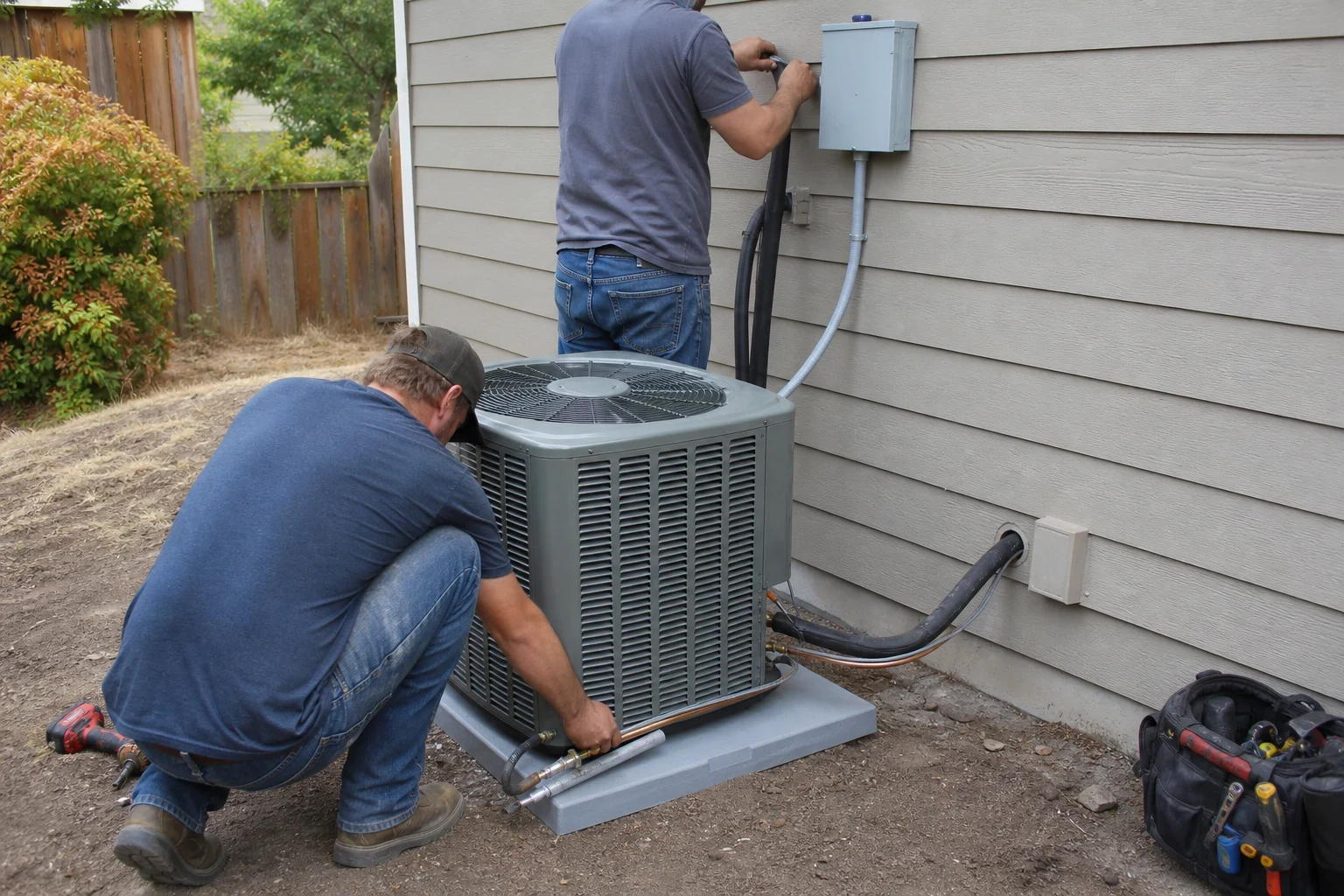
The condenser goes on a level pad with clearance for airflow. We install or verify the outdoor disconnect, the breaker size and the thermostat wiring for the new equipment.
Vacuum, charge and startup
We pull the system down to a deep vacuum to remove moisture, then set the charge by measuring superheat and subcooling instead of guessing by weight alone. A condensate drain test and a safety float switch check finish the startup.
Permit and cleanup
We pull the required permit and arrange the inspection. The old unit and packaging leave with us, and the old refrigerant is recovered, not vented.
Signs it is time for a new air conditioner
- Your system still runs on R-22
- Units built before about 2010 often use R-22, which is no longer produced. Every leak repair means buying scarce reclaimed refrigerant, and that cost climbs each year.
- Repeat failures in one summer
- A capacitor one month and a contactor the next can be ordinary wear. A failing compressor or a leaking evaporator coil on an older unit is usually the point where repair money is better spent on a new system. Our AC Repair page covers the fixes worth making.
- Short cycling and sticky air
- If the unit runs a few minutes, shuts off and starts again, it is often oversized for the house. It never runs long enough to pull moisture out, so rooms feel cool but damp.
- Corroded coils outside
- Fins packed with dust and chaff and coils pitted by corrosion lose the ability to shed heat. Once the coil starts leaking, replacement is often the realistic answer.
- You have a furnace but no AC
- Many homes with a forced-air furnace can add central air by placing a coil on the furnace and a condenser outside. We check the blower and cabinet first to confirm it will work.
How an installation goes, start to finish
- 1
The estimate visit
Your contact walks the house, takes measurements, looks at the furnace, electrical panel and current line set, and asks how the house feels in summer. The estimate is free.
- 2
A written quote
You get a written quote before any work begins, listing the equipment model numbers, the line set plan, electrical work and permit. If there are a couple of sensible options, such as a higher-efficiency condenser, we lay them side by side and explain the difference in plain terms.
- 3
Installation day
We protect floors on the path to the furnace, recover the old refrigerant and remove the old equipment. Then the new coil, condenser, line set and wiring go in, followed by the vacuum and charge.
- 4
Startup and walk-through
We measure temperature split, pressures and amp draw to confirm the system is working as designed. Before we leave, we show you the thermostat settings and filter location, and answer whatever is left.
What moves the cost of a new AC
No two installations are priced the same because no two houses are set up the same. The quote depends on the equipment you choose and on what we find at your furnace, panel and outdoor pad. Everything we find is listed in writing before you decide.
- Tonnage and efficiency
- A larger cooling load means a larger condenser. Higher SEER2 ratings cost more up front and less to run, and we show you where that tradeoff makes sense for your home.
- Coil and furnace fit
- If your furnace blower is weak or the cabinet width does not match available coils, an adapter or a furnace upgrade may be needed. Our Furnace Installation page explains when replacing both at once is worth it.
- Line set condition and length
- A short, clean line set that is compatible with the new refrigerant can be reused. A long run, a buried line or old copper sized for a different system adds material and labor.
- Electrical work
- Some homes need a new breaker, a new disconnect or a dedicated circuit for the condenser. Older panels with no open space add more.
- Permit and access
- The permit fee is part of every job. A condenser location with tight clearance or a furnace in a crawlspace or attic takes extra time.
AC installation questions
- How long does a replacement take?
- A straight swap of condenser and coil in an accessible basement or utility room usually finishes in one day. Adding central air to a home that never had it, or replacing a line set through finished walls, can take longer. Your quote will say what to expect.
- Can you just put in the same size as my old unit?
- We can, but we would rather check first. Homes often get new windows, insulation or additions over the years, and the original unit may have been oversized from the start. A load calculation tells us what your home needs today.
- Should I get a heat pump instead of an air conditioner?
- A heat pump cools exactly like an AC and also heats, which can cut furnace use in spring and fall. With our cold winters it usually pairs with your furnace as backup. We help with claiming Avista rebates and federal tax credits on heat pumps, and our Heat Pumps page goes into the details.
- Who do I call if I have a question mid-job?
- The same person who did your estimate. They schedule the crew, track the permit and inspection, and are the one you call before, during and after installation day.
- How do I keep the new system running well?
- Change the furnace filter on schedule and keep the outdoor coil clear of dust, grass clippings and plants. A yearly tune-up catches low charge and dirty coils early, and our Maintenance Plans page explains what is included.
Ready to plan your new air conditioner
Tell us about your home and your current system, and we will set up a visit to measure and look things over. You get a written quote before any work begins.