ServicesEmergency HVAC Repair
Emergency HVAC Repair in Ritzville
When your furnace quits on a January night or your AC stops in a July heat wave, we pick up 24/7. One person takes your call, sends the tech, gives you a written quote and stays your contact until the system runs again.
What Counts as an HVAC Emergency
An emergency is any failure that makes your home unsafe or hard to live in before a regular appointment would come around. No heat when it is below freezing, no cooling when it is over 100, a furnace that keeps locking out, or a breaker that trips every time the compressor starts.
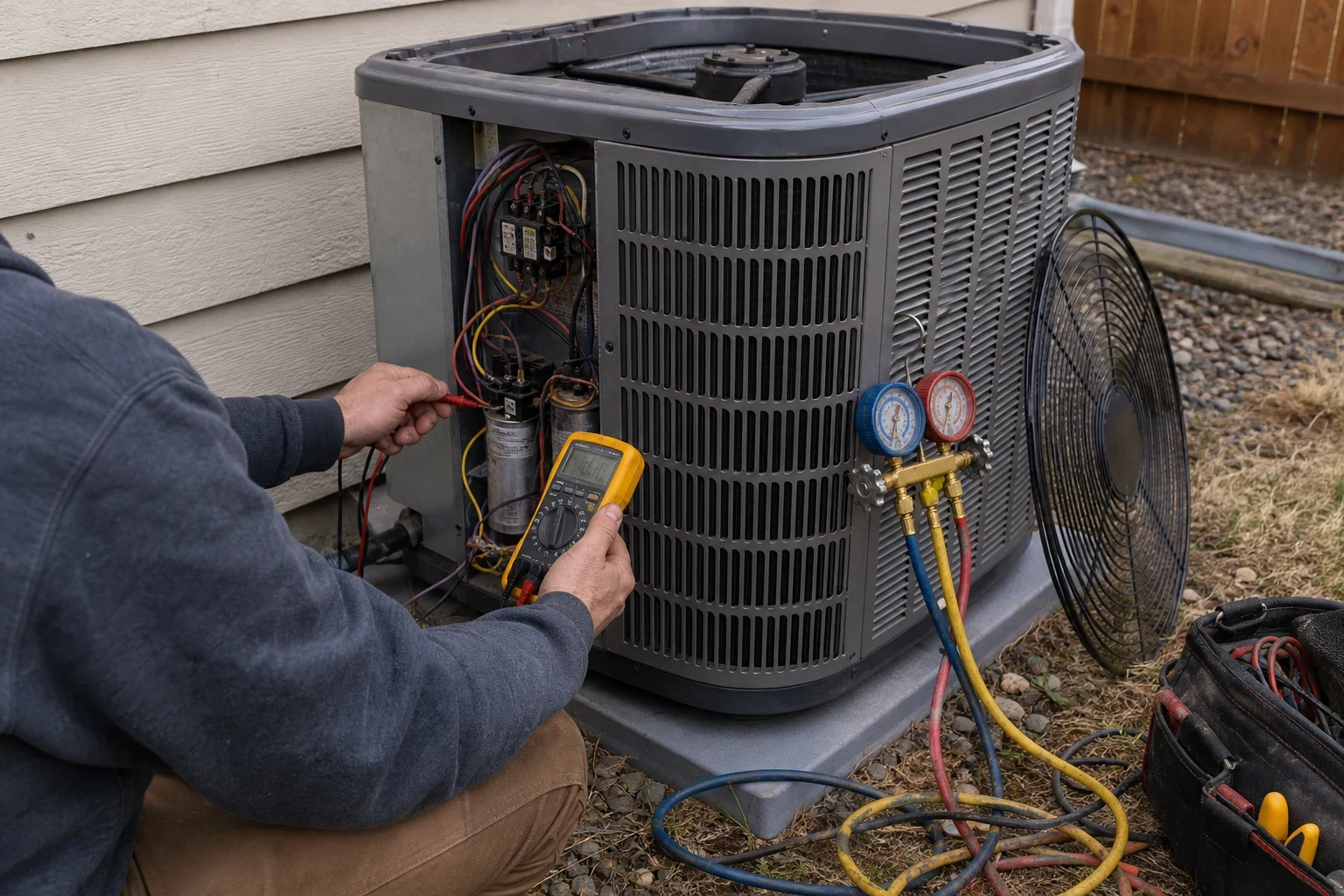
Most of these come down to one failed part: a cracked hot surface igniter, a dirty flame sensor, a burned-out capacitor, a stuck contactor or a seized inducer motor. We carry the common ones on the truck so a night call can end with heat or cooling, not a note saying we will be back.
We charge no emergency or after-hours fees, so a 2 a.m. repair is quoted the same way a Tuesday afternoon one is.
What an Emergency Call Includes
One person from first call to finish
The person who answers your call is the one who dispatches the tech, explains the quote and checks back after. You do not repeat your story to three different people.
Full diagnosis, not a guess
We read the board's fault codes, test voltage and amperage, check gas pressure and temperature rise, and confirm the cause before we name a part. The diagnostic fee is credited toward the repair.
A written quote before any work begins
You see the part, the labor and the total in writing before we touch a tool. If you want to wait for daylight or a second opinion, that is your call.
Safety checks on gas equipment
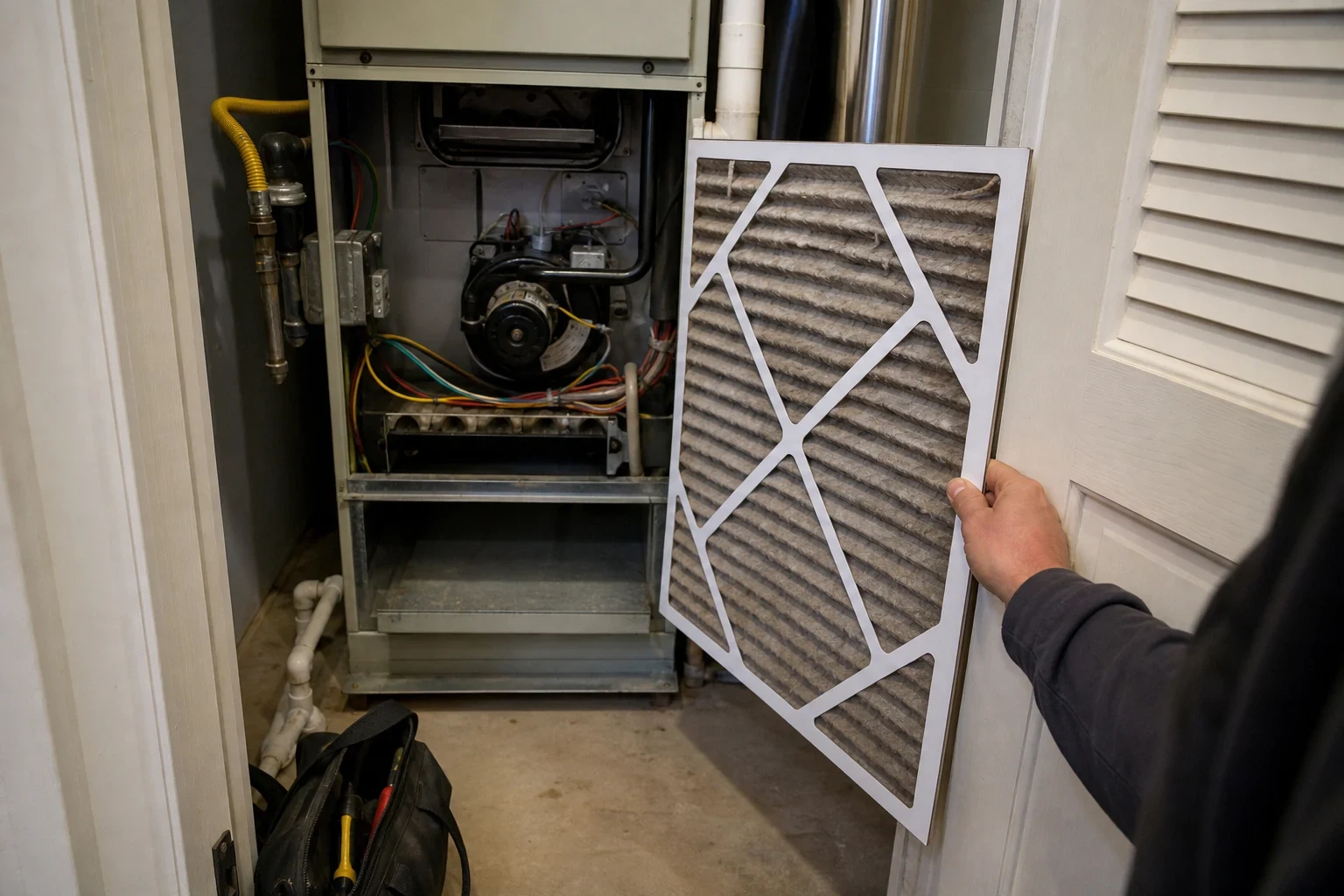
On a furnace we look at the flame, the flue draft and the heat exchanger, and test for carbon monoxide at the appliance. A cracked heat exchanger is a shutdown, and we will tell you plainly if that is what we find.
Common parts on the truck
Igniters, flame sensors, capacitors, contactors, pressure switches and limit switches cover most no-heat and no-cool calls.
A clean exit
Drop cloths go down at the furnace, old parts go with us, and we show you the failed component if you want to see it.
Signs You Should Call Tonight
- No heat in freezing weather
- Indoor temperatures fall fast once the furnace stops, and pipes on exterior walls are the first at risk. If the thermostat calls for heat and nothing happens, call.
- Furnace starts, then shuts off
- A burner that lights for a few seconds and goes out usually points to a fouled flame sensor or a failing pressure switch. The board will lock out after repeated tries.
- Burning smell or tripping breakers
- An electrical smell from the air handler or a breaker that trips on startup can mean a shorted motor or a failed capacitor. Turn the system off at the thermostat and leave it off.
- AC running but blowing warm air
- If the outdoor fan is still or the compressor hums without starting, a capacitor or contactor has often failed. Running it that way can overheat the compressor.
- Carbon monoxide alarm or gas smell
- Leave the house first and call the gas utility or 911. Once they clear it, call us to find the cause and repair it.
How an Emergency Repair Runs
- 1
You call, we listen
We ask what the system is doing, any codes on the board's blinking light, and what you have already tried. Sometimes a tripped float switch or a dead thermostat battery is the whole problem, and we will tell you that on the phone.
- 2
The tech arrives and diagnoses
We test the sequence of operation step by step until the failed part shows itself. You get the cause explained in plain terms.
- 3
Written quote, then the fix
You approve the quote, we make the repair and run the system through full cycles to confirm it holds.
- 4
Follow-up from the same contact
The person who took your first call checks in afterward. If a larger repair or replacement makes sense later, we schedule it during normal hours with no pressure tonight.
What Moves the Cost of an Emergency Repair
There is no premium for nights, weekends or holidays, so the price comes down to what failed and what it takes to fix it. You get that number in writing before work starts.
- The part that failed
- A flame sensor or capacitor is a small part and a short job. An inducer motor, control board or compressor component costs more and takes longer.
- Equipment type and age
- Older furnaces and some heat pump models use parts we may need to source, which can mean a safe temporary fix tonight and a final repair later.
- Refrigerant work
- A short charge never just happens; it means a leak at a coil, a fitting or a valve core. Tracing it, sealing it and weighing in the correct charge takes longer than swapping a part, and the refrigerant itself is billed by the pound.
- Where the equipment sits
- Labor is measured in time, and reach matters. A unit under the floor or up in the rafters means crawling in with lights and tools before testing can start, while one standing in an open basement or garage can be opened up in minutes.
Emergency HVAC Repair Questions
- Do you really charge the same at night?
- Yes. We have no emergency or after-hours fees. The diagnostic fee and the repair are priced the same whether we come at noon or midnight, and the diagnostic fee is credited toward the repair.
- What should I do while I wait for the tech?
- Turn the system off at the thermostat if you smell burning or hear grinding. In winter, close interior doors to hold heat in occupied rooms and open cabinet doors under sinks on outside walls. Do not keep resetting a furnace that locks out, because repeated tries can flood the burner area with unburned gas.
- Can you fix it on the first visit?
- Most no-heat and no-cool calls are a common part we carry. If the part is specific to your model, we will make the system safe, explain the options and order it, and the same contact will keep you updated until it is installed.
- Will you push me to replace the system?
- No. If a repair makes sense, that is what we quote. If the heat exchanger is cracked or the compressor has failed on an older unit, we will say so and lay out repair and replacement costs side by side so you can decide in daylight.
- Do you handle heat pumps and mini-splits after hours?
- Yes. We diagnose defrost board failures, reversing valve problems and inverter faults on heat pumps and ductless mini-splits, along with furnaces and central AC.
No Heat or No Cooling Right Now
Tell us what the system is doing and we will send a tech, any hour. You get the cause, a written quote and one person to talk to until it is fixed.